💡 Catholic Marriage 101: What Makes a Catholic Wedding Special
- Catholics view marriage as a sacrament – a sacred covenant before God. It’s both a lifelong promise to each other and a commitment to live out your faith together.
- The Catholic Church requires that marriages be entered into freely and with proper preparation. These rules ensure you’re ready for the commitment and the sacrament.
- Preparing for marriage isn’t just red tape: it’s time to reflect on your love and future together. In a Catholic wedding, you won’t just walk down the aisle – you’ll be spiritually ready, too! 🕊️
Before diving in, here’s a quick summary of the main requirements at a glance:
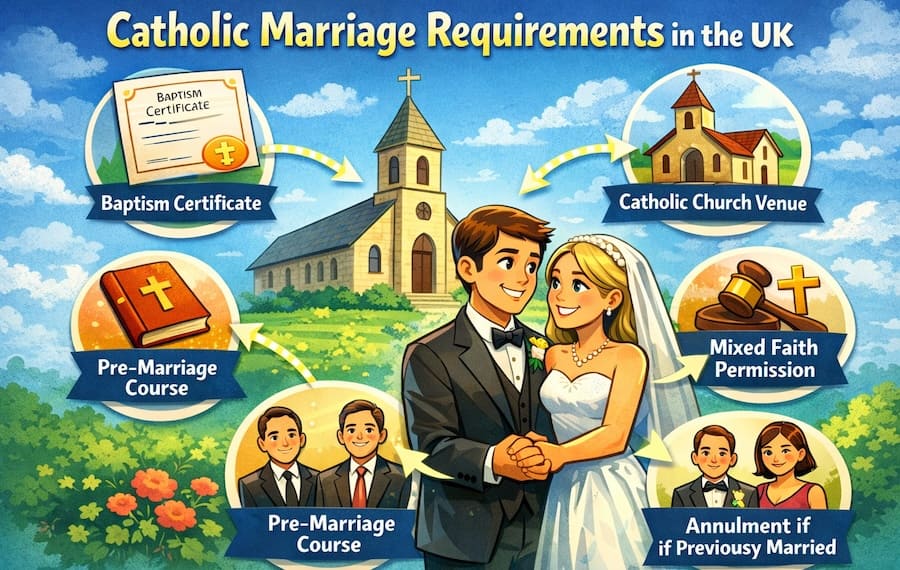
| Requirement | Details |
| Free to Marry | Both partners must be single and free of previous marriage bonds (or have annulments). |
| Notice Period | Typically 6 months’ notice given to your parish priest (sooner is better). |
| Marriage Preparation | Completion of a Church-approved marriage course (e.g. a Pre-Cana or Engaged Encounter). |
| Baptism & Confirmation | Original, recently-issued (usually within 6 months) certificates of Catholic baptism (and confirmation, if applicable) for each Catholic party. |
| Certificate of Other Faiths | If one partner is another Christian, a recent baptism certificate from their church is usually needed. |
| Freedom Declaration | A declaration (often a sworn statement) confirming you are free to marry, signed with a priest or official. |
| Permissions/Dispensations | Required if marrying outside the Catholic Church (permission for a mixed marriage, dispensation for disparity of cult) or outside your home parish. |
| Witnesses | At least two witnesses (usually the best man and maid of honour) must attend the ceremony. |
| Venue | A Catholic Church (or approved Catholic chapel) – permission is needed to marry elsewhere. |
| Children’s Promise | If one partner isn’t Catholic, the Catholic party must promise to practice the faith and raise any future children Catholic. |
This table gives you a snapshot of what’s needed. 📋 Below, we’ll explore each requirement in more detail so you know the why and how behind every step.
Meet Your Priest First 📝
Your very first step should be to talk to your local Catholic priest. Your parish priest will guide you through the whole process, answer your questions, and help you book your wedding date. Think of it as the starting line of your wedding journey!
- Why start with the priest? The Church asks that you meet the priest before booking any venues or spending on flowers or photos. This makes sure you’re on the right track with Church law.
- Choose your parish: Normally you’ll marry in the parish church where one of you lives (or where your family is registered). If one partner lives outside the area, discuss with the priest whether you can marry in a different church – you may need special permission.
- Previous marriages: If either of you has been married before, it’s important to tell the priest right away. Catholic rules mean previous marriages must be examined first. The priest will explain what happens (for example, whether a Catholic annulment is needed) before any date can be set.
- Set a date: Once you’ve met the priest and cleared any issues, you’ll normally fix a wedding date in the church’s calendar. Remember that six months’ notice is typically required by Church law (some dioceses suggest a year or more). Many couples choose to book a year ahead to allow plenty of time.
Tip: Don’t set any dates or spend on receptions until you’ve spoken to the Church. ⛔ You could otherwise find out later that you haven’t completed an important step. Meeting the priest first means you’ll know exactly which documents and preparation you need before moving on.
Timeline: When to Start Planning ⏰
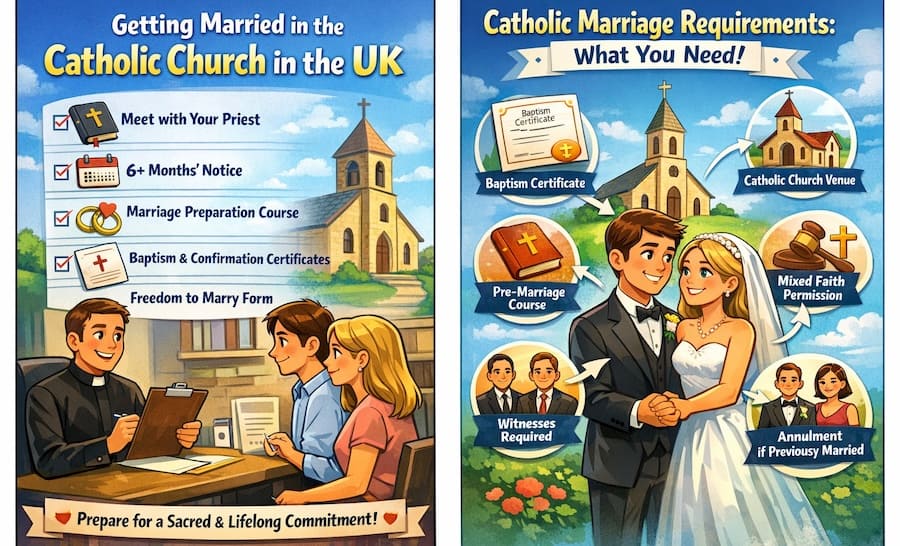
Most couples find it helpful to approach the wedding year methodically. By planning in stages, you avoid stress and make sure nothing is missed. Here’s a broad timeline once you’ve decided to marry in the Catholic Church:
12–9 Months Before the Wedding 🗓️
- Contact your priest and set a date. Secure your spot in the parish calendar. The priest will note your intent and start the paperwork clock.
- Enroll in a marriage preparation course. Many courses (retreats or weekly classes) book up fast, so sign up early.
- Begin collecting documents. Reach out to the church where you were baptised for a recent baptism certificate (issued within the last 6 months). If you were confirmed as a Catholic, request that certificate too.
6–9 Months Before 🗓️
- Finish your marriage course. Complete the required sessions or retreat so you can obtain a certificate of completion.
- Gather all paperwork. Obtain your baptism and confirmation certificates, and any proof of Catholic practice if requested. Have passports or birth certificates ready for ID.
- Attend any parish-specific sessions. Some dioceses require a parish-led “Saturday Day” course or additional workshops. Ask your priest what your parish does.
4–6 Months Before 🗓️
- Pre-nuptial meeting with the priest. Together with your partner, sit down with the priest to fill out official forms. You’ll complete the Pre-Nuptial Enquiry form (personal details and family history) and sign the Declaration of Freedom to Marry.
- Permissions and dispensations. If one partner isn’t Catholic, or if you’re marrying outside your local parish or country, the priest will request the needed permissions from the bishop. You may have to sign promises, especially about raising children in the Catholic faith.
- Plan the ceremony. Decide on Scripture readings, hymns, and whether you’ll have a Nuptial Mass(full Mass) or a simpler Marriage Service (liturgy without Eucharist). Confirm these choices with your priest.
2–3 Months Before 🗓️
- Banns of marriage. In many parishes, your wedding will be announced at Sunday Masses (usually 3 consecutive Sundays) before the date. This is to ensure there are no objections or undisclosed impediments.
- Resolve any issues. If anything unexpected pops up (e.g. a surprise need for an annulment or a last-minute dispensation), work with your priest now to clear it before the wedding date.
Final Month (Last 4 Weeks) 🗓️
- Rehearse. Schedule a rehearsal (usually a few days before the wedding) to run through the ceremony with the priest or deacon.
- Relax and reflect. By this point, all preparation and paperwork should be complete. Enjoy the joyful anticipation and make time for a bit of quiet reflection (and prayer) before the big day.
Following this timeline ensures you meet the Catholic Church’s requirements on time. Starting early (ideally a year ahead) keeps things smooth, so you’re free to enjoy celebrating your faith and love as you approach the altar.
Catholic Marriage Preparation (Marriage Courses) ❤️
Marriage preparation is one of the most important requirements for a Catholic wedding in the UK. It’s not optional – the Catholic Church mandates it. The idea is to help engaged couples strengthen their relationship and faith before exchanging vows. Think of it as building a strong foundation for your marriage! 💪
There are several formats for Catholic marriage preparation in the UK:
- Engaged Encounter (Marriage Encounter): A weekend retreat for engaged couples. These focus on improving communication and understanding as a couple, often through talks and private discussions.
- Marriage Care Courses: A well-known Catholic charity offering courses (weekend or online) called “Preparing Together” or “Marriage Care weekends.” They cover practical and spiritual topics and provide a certificate of completion for the priest.
- Parish/Diocesan Programmes: Many parishes or dioceses run their own courses (sometimes called Pre-Cana). These might be weekly sessions at the parish church or meetings with the priest or a mentor couple.
- Online/Catechism Courses: Some couples use approved online programs or self-study guides (especially if distance or scheduling is an issue). Even so, the priest will usually still meet you to discuss what you learned.
What to expect: Marriage prep usually involves a few sessions or a weekend retreat where you discuss topics like communication, family life, finances, and faith. You may fill out a questionnaire (such as FOCCUS) to prompt meaningful conversation. At the end, you receive a certificate confirming you’ve completed the program – this is required by the Catholic Church before you can marry.
Key points to remember:
- 📜 Certificate: Keep the certificate or letter of completion; your priest will need to see it during the paperwork meeting.
- 📅 Timing: You can do marriage prep up to 2 years in advance, but remember the final paperwork with the priest must still happen within 6 months of the wedding date. So it’s fine to prepare early, but finalize documents closer to the wedding.
- ✝️ Faith focus: Be ready to discuss your faith life. If one partner is not Catholic, the preparation will cover how you’ll practice religion together and raise future children in the faith.
- 🤝 Together: Both partners should attend all sessions together. These meetings are for you as a couple, so come prepared to participate fully and be honest.
Marriage preparation courses aren’t just red tape – many couples say they find them eye-opening and helpful. They can even be fun: some weekend retreats have a real “getaway” feel. The best part is you’ll enter your marriage with greater confidence and understanding, which is a blessing in itself.
Essential Documents and Paperwork 📂
You’ll need to collect a number of official documents. Start gathering these early so you’re ready for meetings with the priest. Below is a checklist of the common paperwork required for a Catholic marriage:
- Baptism Certificate (Catholic Church): If you’re Catholic, you must obtain your original baptism certificate from the church where you were baptized. It should be a recently-issued copy (usually dated within 6 months of your wedding) to confirm your Catholic baptism. If you were baptized as a child, that parish should still have a record. (If a recent copy isn’t possible, discuss it with your priest – sometimes an older certificate or a letter from your parish may suffice.)
- Confirmation Certificate: If you were confirmed in the Catholic Church, bring that certificate too. In the UK it’s encouraged that Catholic couples have been confirmed. If you haven’t been confirmed, speak to the priest; you may be advised to arrange your Confirmation before the wedding.
- Birth or ID Documents: Have passports, birth certificates or similar ID on hand. Some parishes ask for these to verify your name, birthdate, and place.
- Proof of Catholic Practice: In some dioceses the priest may ask for a “Certificate of Catholic Practice” – essentially a letter from your parish priest stating you are known to attend Mass regularly. This usually only applies if you or your family have been absent from a parish for a while.
- Pre-Nuptial Enquiry Form: This is a standard Church form that you’ll complete together with your priest. It asks questions about your personal details, family background, and any previous marriages or baptisms. You typically fill in most answers in advance and then sign the completed form with the priest.
- Statutory Declaration of Freedom to Marry: Each of you will make a formal statement that you are free to marry (meaning you’re not currently bound by another marriage or any other impediment). In many UK dioceses this takes the form of a Statutory Declaration signed before a Notary or Commissioner of Oaths (for a small fee). The parish provides the form after your prep course. (NB: If you are already civilly married to each other and are having a Catholic “blessing”, you may not need this declaration.)
- Previous Marriage Documents (if applicable): If either of you has been married before (civilly or otherwise), tell the priest at the start. You’ll likely need to provide the divorce decree or death certificate from that marriage. You’ll also discuss whether a Catholic annulment is required. (No Church wedding date will be set until any previous marriage issue is resolved.)
- Permissions/Dispensations:
- Mixed Faith: If one partner is Catholic and the other is a baptized non-Catholic Christian, you’ll need to request permission for a mixed marriage from the bishop. If one partner is Catholic and the other is not baptized, a dispensation from disparity of cult from the bishop is required. These are handled by your priest. (You will usually sign promises about faith and children as part of this.)
- Other Parishes or Abroad: If you want to marry outside your home parish or even outside the UK, there are additional permissions needed. For example, marrying in a church of another diocese (or country) still requires your bishop’s approval. Plan extra time – marrying abroad often means sending paperwork internationally, which can add 3–6 months to the process.
- Fees and Donations: Parishes often have suggested donations (for example, £100–£200) to cover church expenses, music, or upkeep. There may also be small fees (for the marriage course, statutory declaration, etc.). It’s best to ask your priest what costs to expect. If money is a concern, many parishes are understanding, so don’t hesitate to ask.
Organising the paperwork can seem daunting, but your priest will guide you step by step. Pro tip: Keep a folder with copies of every document you submit. This way you can track what’s done and what’s outstanding. It’s better to have everything ready than to make frantic last-minute calls to parishes.
Pre-Nuptial Enquiry and Freedom to Marry 🖋️
When you meet with the priest for your official paperwork appointment, you’ll complete these key steps:
- Pre-Nuptial Enquiry Form: You’ll fill this out with the priest. It collects basic details (names, birthdays, baptism dates, etc.) and asks about any previous marriages or special issues. Even if you’ve prepared most answers beforehand, you will sign it in front of the priest.
- Declaration of Freedom: Each partner will sign a statement under oath that you are free to marry (no living spouse from a previous marriage, not too closely related, etc.). This is often done via the Statutory Declaration mentioned above. Think of it as a safeguard to ensure your marriage is valid in the eyes of the Church.
- Promise to Raise Catholic Children: If one of you is not Catholic, you will each promise to raise any future children in the Catholic Church. This promise will be written on the form and signed in front of the priest. It’s the Church’s way of ensuring the Catholic faith is preserved in mixed marriages. (This promise is a requirement even if one spouse is, say, Anglican or Orthodox.)
Your priest will review all this with you, usually in a single meeting. It’s a good idea to bring all your documents to this meeting. When you leave, the parish will send your completed forms to the diocesan office, and any necessary permissions will be finalized behind the scenes.
Getting Married in a Church 💒
Catholic weddings in the UK are almost always held in a consecrated Catholic church or chapel. This is because the Church teaches that marriage is a public act of worship and belongs in a sacred space. Here’s what to know:
- Your Parish Church: Most couples marry in the church where one of them belongs. This is the simplest route – you’ve already prepared your documents in that parish.
- Another Catholic Church: You may marry in a different Catholic church (say, a beautiful cathedral or your fiancé’s home parish). You still do all your preparation in your home parish first. Your priest will then send the paperwork to the new church’s diocese. Make sure to arrange this early so everything is in both parishes’ calendars.
- Marrying Abroad or Elsewhere: In very exceptional cases (for example, if one partner is seriously ill in a hospital chapel), the Church can grant an exception to marry outside a Catholic church. Also, if one of you is not Catholic, some couples wonder about marrying in a Protestant church. This requires special permission from the bishop (dispensation from canonical form), and it’s quite rare. If you have a non-standard venue in mind, discuss it with your priest as soon as possible.
- Who Can Officiate: A Catholic wedding must be celebrated by a Catholic priest or deacon (or with the bishop’s permission, even a visiting priest). Unlike a civil ceremony, you cannot choose a friend or family member to officiate unless they are ordained Catholic clergy.
Banns of Marriage: Traditionally, Catholic parishes publish banns (announcements) of the marriage at Mass on three consecutive Sundays before the wedding. This is to ensure no one is aware of an impediment. Your priest will let you know if your parish follows this practice. Either way, it’s a formality to safeguard the sacrament.
Mixed-Faith Marriages ❤️✝️
It’s common for couples to come from different Christian traditions. The Catholic Church allows a Catholic to marry a baptized non-Catholic (e.g. Anglican, Methodist, Orthodox), but with a couple of conditions:
- Permission for Mixed Marriage: The Catholic party will need the bishop’s permission (via your priest) to marry a baptized non-Catholic. Nowadays this permission is routinely granted. The wedding ceremony itself will still be the Catholic Rite, though you might include special readings or prayers from your partner’s tradition if arranged in advance.
- Dispensation for Disparity of Cult: If a Catholic marries someone not baptized in any church, that’s “disparity of cult.” A dispensation from the bishop is required to allow the marriage. In practice, this usually means having a shorter ceremony (a Marriage Service instead of a full Mass), and clear communication about faith promises.
- Promises: In both cases, the Catholic spouse (and the other spouse) will promise — typically in writing — to continue practicing the Catholic faith and to baptize and raise all children Catholic. This is called a “promise to uphold the Catholic faith.” It doesn’t force the other spouse to convert, but it does mean you both commit to the Catholic side for the family. The priest will make sure you understand and make this promise.
- Ceremony Details: Generally, the wedding you will celebrate is the Catholic ceremony. Any involvement of another church’s minister (for example, a blessing at the end) must be arranged very carefully with your priest and the bishop.
- Holy Communion: At a Nuptial Mass, only baptized Catholics may receive Communion. The non-Catholic spouse may receive a blessing instead. This is simply how the Church’s sacraments work.
The bottom line: Mixed marriages are fully possible and common. They just require some additional paperwork and discussion. The Church’s aim is to ensure both partners understand the Catholic commitments involved. Be open and honest with your priest about your faith backgrounds – they will guide you through the process kindly.
Divorced? Understanding Annulments 🔄
If either of you has been married before, it’s very important to deal with that before your Catholic wedding:
- Church Teaching: The Catholic Church teaches that a valid marriage, if it was a true sacramental marriage, is indissoluble. A civil divorce alone does not free a Catholic to remarry in the Church.
- Annulment: An annulment (officially a “declaration of nullity”) is a Church finding that a valid marriage never actually existed sacramentally. If you or your fiancé was previously married (civilly or otherwise), you will need to pursue an annulment before marrying in the Church, unless the former spouse has died. The Church asks: “Was the sacrament truly there from the start?” If not, an annulment is granted.
- If the previous spouse has died, you do not need an annulment (just provide a death certificate to your priest).
- The annulment process involves filling out paperwork and sometimes interviews about the first marriage. It can take several months.
- What to do: Don’t get engaged or spend on wedding plans until the priest has looked into the previous marriage situation. If an annulment is needed, the priest will guide you. It’s best to start this as soon as possible. The parish won’t set your wedding date until all is resolved.
- Civil Divorce vs. Annulment: Remember, a civil divorce (in court) doesn’t mean the same thing as a Church annulment. Even if you are legally divorced, the Church still needs to confirm the first marriage’s status.
In short, be open with your priest about any past marriages. The process can sound complicated, but the Church is there to help you find clarity. The goal is that no wedding date is firm until you are free to marryaccording to the Church.
Frequently Asked Questions (FAQs) ❓
- Q: How long before the wedding should we start planning?
A: Ideally 12 months ahead. Canon Law says at least 6 months’ notice, but many couples start a year before. This gives time for all paperwork, courses, and any unforeseen issues (like an annulment) without rushing. - Q: Can we get married anywhere in the world?
A: For a Catholic ceremony, you normally marry in a Catholic church, either your parish or one you’ve chosen. If you want to marry abroad in a Catholic church, you’d still do the paperwork in a UK parish first; then that parish would coordinate with the foreign diocese. This takes extra time (plan 3–6 additional months). Always speak to the priest early if an international wedding is planned. - Q: Do both of us have to be Catholic?
A: Not necessarily. The Church requires at least one spouse to be a baptized Catholic. The other person can be a baptized Christian of another church, or even non-baptized (with a dispensation). The key is being honest and making the required promises. (See the Mixed-Faith section above for details.) - Q: What if one of us isn’t baptised at all?
A: A Catholic marrying someone who isn’t baptized is possible but less common. It requires a dispensation (“disparity of cult”). The ceremony will be a Marriage Service (no Mass), and the Catholic partner must promise to keep the faith and raise children Catholic. It will all be explained by the priest – it’s definitely feasible with preparation. - Q: Do we need Confirmation certificates?
A: If you’ve been confirmed, bring the certificate. In UK practice, being confirmed is encouraged for Catholic weddings (you’re generally expected to have received your sacraments of initiation). If one of you isn’t confirmed, your priest will advise you – often you’d be asked to make Confirmation first. - Q: What’s the difference between a Nuptial Mass and a Wedding Service?
A: A Nuptial Mass is a full Mass that includes your wedding vows (and the congregation receives Communion). A Marriage Service (sometimes called a service of marriage) is the wedding liturgy without a Mass – it has prayers and readings and the vows, but no Eucharist (often used if one partner is not Catholic). This choice affects who can receive Communion, but does not affect the Church’s requirements to marry. - Q: Is there anything else after we’re married?
A: Once you’ve exchanged vows in the Catholic Church with the proper paperwork done, you’ll leave as a married couple in the eyes of God. The Church ceremony itself is a sacrament – no further Church step is needed to make it valid. You can now focus on celebrating with family and living out the promises you made, for example by participating in Mass together and raising any future children in the faith. - Q: We’re not from the UK – can we still marry in a UK Catholic church?
A: Yes, absolutely. The process is the same. Usually you would do all the preparation in a UK parish (your local UK parish or the parish of the church where you’ll marry). Just make sure your baptism certificate is translated or properly prepared if it’s from another country. If you plan to marry in your home country’s church instead, you’d coordinate with that country’s Church similarly (start early and let both bishops’ offices know). - Q: What if one of us hasn’t been confirmed yet?
A: If only one of you is Catholic (and that person isn’t confirmed), the priest will likely encourage that person to receive Confirmation before the wedding. Some parishes let engaged couples take Confirmation classes together. In practice, many couples go through Confirmation during the engagement. If Confirmation can’t happen in time, sometimes the priest will still marry you, but the spirit of the preparation is that you should make Confirmation as part of preparing fully for the sacrament of marriage. - Q: What if I’m not from the same parish as my partner?
A: Normally at least one of you should be a member of the parish where the wedding will take place. If you want to marry in one parish but live in another, you may need letters of freedom or permission from both parish priests (and possibly a dispensation from the bishop of one diocese to the other). Your priest will advise; it’s quite common and usually can be arranged with a bit of paperwork. - Q: Do we need to pay for anything?
A: Policies vary by parish. Many parishes ask for a donation or stipend (often around £100–£200 total) for the church and priest. There may also be fees for things like the marriage preparation course or the statutory declaration. This is more suggested donation than a strict fee – always talk to your priest if finances are an issue, as many parishes can work with you. - Q: Can we choose our own readings and music?
A: Yes, you usually can choose Scripture readings (from approved options) and hymns for your ceremony. Your priest or music director will help ensure your choices fit the liturgy. Everything you pick should be appropriate for worship (so no secular songs, etc.). The priest will guide you through this in the months before your wedding.
Final Thoughts 💖
Planning a Catholic wedding in the UK involves a few more steps than a civil ceremony, but each one is meant to prepare and bless your union. By meeting with your priest, completing the marriage preparation course, and gathering the necessary documents, you’ll make sure your marriage is fully valid and celebrated as a sacrament.
Remember:
- Be proactive: Start early, especially if there are any special cases (mixed faith, previous marriages, or marrying abroad).
- Stay connected: Keep in close contact with your parish priest or deacon throughout the process. They’re there to help, not to hinder.
- Embrace the preparation: Many couples find that the journey deepens their love and understanding of each other. It’s not just paperwork – it’s a chance for you and your partner to pause together, reflect, and grow spiritually before you marry.
With this guide and the support of your Church community, you’ll be well prepared to walk down that aisle and celebrate your beautiful Catholic wedding. Best wishes to you both on this exciting journey! 🥂👰🤵
If you want to find items related to 💡 Catholic Marriage 101: What Makes a Catholic Wedding Special, you can search in Blog.
Related